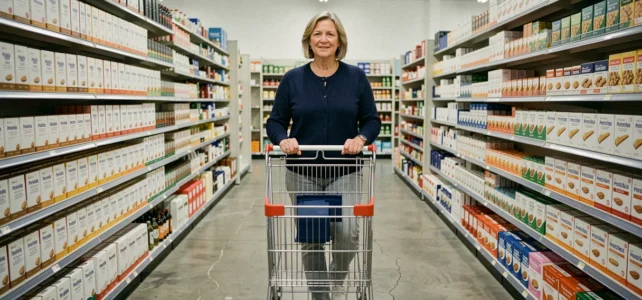
Aldi operates more than 10,000 points of sale worldwide, divided between two legally distinct entities. Behind this uniform facade lies a business mechanism whose springs have changed little since the 1940s, even though the brand now invests hundreds of millions of euros each year to transform its image in France. Measuring the gap between the historical model and the current strategy helps to understand what still distinguishes Aldi from its direct competitors.
Aldi Nord and Aldi Süd: two entities, two measurable strategies
The split dates back to 1961, when Karl and Theo Albrecht parted ways over the issue of selling cigarettes in stores. The result: two independent groups that share geographic markets without competing directly.
| Criterion | Aldi Nord | Aldi Süd |
|---|---|---|
| Main Founder | Theo Albrecht | Karl Albrecht |
| Key European Markets | France, Belgium, Netherlands, Poland | Southern Germany, Austria, United Kingdom |
| Presence Outside Europe | No | United States, Australia |
| Recent Positioning | Accelerated modernization of stores | Upgrading of product range |
In France, it is Aldi Nord that operates the entire network. This distribution explains why the in-store experience differs significantly from one country to another, even though the name remains the same.
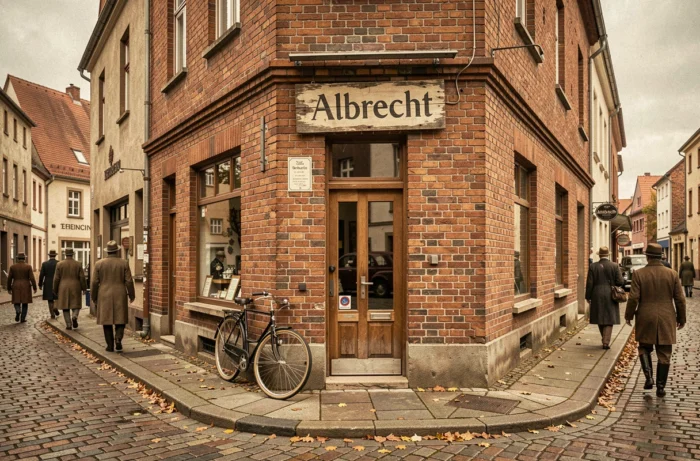
To learn everything about Aldi’s mysterious origins, one must go back well before the split: the family grocery store opened in 1913 in Essen, and it was in 1947 that the Albrecht brothers established the discount principle that still structures the group.
Short Range and Private Labels: Aldi’s Discount Engine
The Aldi model is based on a principle that has not changed in several decades: a deliberately reduced assortment, dominated by private labels. While a hypermarket references several tens of thousands of products, Aldi offers a fraction of that.
This restriction is not a disadvantage. It generates concentrated purchase volumes on each reference, which strengthens the negotiating power with suppliers. The result is directly visible on the shelves: prices several percentage points lower than those of generalist brands on everyday products.
- Private labels cover the vast majority of the shelf space, from fresh products to cleaning items.
- Major national brands only appear occasionally, often in limited-time promotions.
- Each category contains only a few references, compared to dozens at traditional competitors.
This choice comes at a cost in terms of service: in-store advice remains minimal, and the depth of range does not suit all buyer profiles. However, for a standard basket of weekly groceries, the price gap with traditional brands remains the central argument.
Aldi France Expansion Plan: Goal of 1,600 Stores
Aldi is no longer content to defend its positions. The brand has communicated a specific goal for France: by 2030, every French person should have access to a store within a 15-minute journey. This implies about 287 additional openings to move from the current network of around 1,300 points of sale to 1,600 stores.
This territorial network logic relies on an unusual metric in large distribution: time-distance rather than simply counting points of sale. Some regions, such as Auvergne-Rhône-Alpes, concentrate eight to nine real estate projects per year, mixing new openings, transfers, and reconstructions.
Annual Investment and Modernization of the Store Network
The group announces an investment of around 500 million euros per year to finance this expansion and the renovation of the existing network. The bulk of the budget is not used to open new stores, but to modernize those already in place: new layouts, an expanded range of fresh products, better signage.
This orientation distinguishes the current phase from the historical strategy. For decades, Aldi prioritized absolute sobriety in stores (pallets on the floor, minimal lighting). The recent transformation aims to attract a clientele that previously avoided hard discount by choice.
Sustainability and Regenerative Coffee: Aldi’s Recent Commitments
Aldi Süd has invested in a project targeting the production of regenerative coffee, with a goal of several hundred thousand tons per year. This initiative illustrates a shift towards concrete environmental commitments, beyond mere statements of intent.
On the packaging side, Aldi and Arla have launched a pilot using UV markings on milk bottles to trace plastic recycling. This type of technology allows for measuring actual collection and recycling rates, not just declared rates.
- Partnership with Polytag for UV tracking of dairy packaging.
- Medium-term goal of carbon neutrality in the supply chain.
- Development of regenerative coffee supply chains through Aldi Süd.
These programs are largely driven by Aldi Süd, raising questions about their effective deployment in the Aldi Nord network, and thus in France.
Family Origin and Opaque Governance: What the Numbers Don’t Show
Aldi remains a privately held company. The two branches are controlled by family foundations, which drastically limits financial transparency. No consolidated annual report is published in the sense understood by financial markets.
This opacity contrasts with the scale of the group. Karl Albrecht was among the world’s wealthiest individuals before his death. Governance by foundations protects the company from short-term shareholder pressures but makes any comparative analysis with Lidl or Carrefour inherently incomplete.
The story of Aldi is as much about the rigor of the discount model as it is about this unique legal structure. The French expansion plan targeting 2030, with its 1,600 stores aimed for and its 500 million euros annual investment, constitutes the best current indicator of the group’s trajectory in the French market.