
You open a free manga site on your phone, scroll through two pages, and a window pops up: “Your device is infected, click here.” Most readers close the pop-up without thinking. The problem is that the damage is sometimes already done. Pirated manga platforms expose their visitors’ personal data to threats that far exceed the simple legal risk associated with piracy.
Malicious scripts on pirated manga sites: what runs before the click
It is often assumed that the danger comes from a file downloaded voluntarily. In practice, scripts can execute as soon as the page is opened, without the visitor clicking on anything. Pirated scan sites use unregulated advertising networks that embed code in banners or redirects.
The most discreet mechanism is called drive-by download. An outdated browser or operating system can be exploited by a script embedded in the page. The result: malware installed in the background, capable of collecting credentials, session cookies, or files stored on the device.
Forced redirects are another common vector. You click on “next page” to read the next chapter, and the browser opens a tab to a third-party site that mimics a Google login page or an age verification form. This type of phishing directly captures the entered credentials. As detailed in a review of mangadorfree by 42 Le Mag, some platforms combine several of these techniques on a single reading page.

Cryptojacking and free mangas: when your phone mines cryptocurrencies
Cryptojacking remains a little-discussed angle when talking about illegal scan sites. The principle is simple: a JavaScript script embedded in the page uses the visitor’s device processor to mine cryptocurrency for the benefit of the site operator.
The symptoms are recognizable:
- The phone or computer heats up abnormally during reading, even on pages that contain only static images
- The battery drains at an unusual speed, sometimes two to three times faster than on a standard site
- The PC fan runs at full speed while no heavy applications are open
Cryptojacking does not directly steal your data, but it degrades your hardware and indicates that the site in question has no qualms about exploiting its visitors. If operators mine via your browser, they will not hesitate to integrate other data collection scripts.
Collection of personal data: what pirate sites know about you
On a legal platform like Mangas.io, data collection is governed by GDPR. The visitor gives consent, can exercise their rights of access, rectification, or deletion, and knows exactly what data is being processed.
On a pirate site, no legal framework protects the collected data. Tracking techniques go far beyond the IP address. Browser fingerprinting crosses dozens of parameters: screen resolution, installed fonts, active extensions, time zone, system language. This combination is enough to identify a unique user without a cookie.
The retrieved information also includes the time of consultation, the referring site (where you came from), and your browsing path on the platform. This data feeds profiles sold on parallel markets or is used to personalize subsequent phishing campaigns.
Registration and trap forms
Some free manga sites require you to create an account to “unlock” chapters. You enter an email address and a password. The problem is that the majority of users reuse the same password across multiple services. A credential obtained from a pirate site will be automatically tested on dozens of platforms (messaging, social networks, banking services).
Forms that ask for a phone number “for verification” or banking details “for a free trial” are classic traps. No pirate platform needs this information to distribute scans.
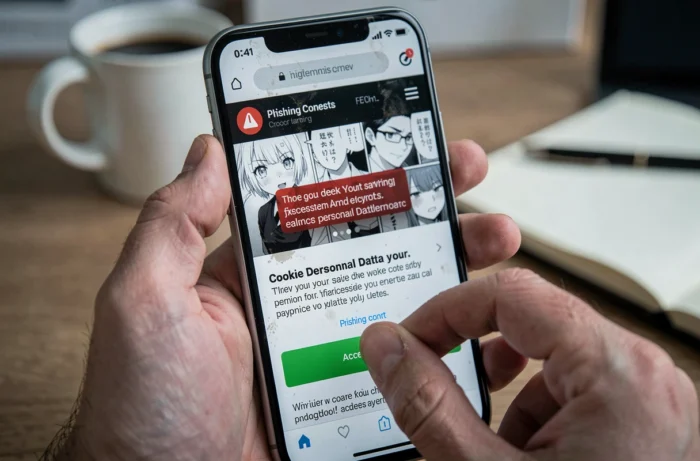
Data protection and reading mangas: concrete reflexes
Rather than listing obvious points, let’s focus on the actions that truly make a difference against the threats described above.
- Keeping the browser and operating system up to date neutralizes the vast majority of drive-by downloads, which exploit already patched vulnerabilities
- Using an ad and script blocker (like uBlock Origin) cuts off malicious advertising networks and cryptojacking scripts before they execute
- Never enter credentials or passwords on a pirated scan site, even if the interface looks professional
- Checking the CPU usage of the browser after opening a suspicious site can help identify a potential mining script
Feedback varies on the effectiveness of free antivirus software against cryptojacking embedded in web pages, but a script blocker remains the first line of defense on such sites.
Legal online reading platforms (Mangas.io, publisher subscriptions, digital libraries) handle personal data according to GDPR rules and offer oversight over their use. The cost of a monthly subscription represents a fraction of what a compromise of a bank account or identity theft related to data harvested from a pirate site can cost.