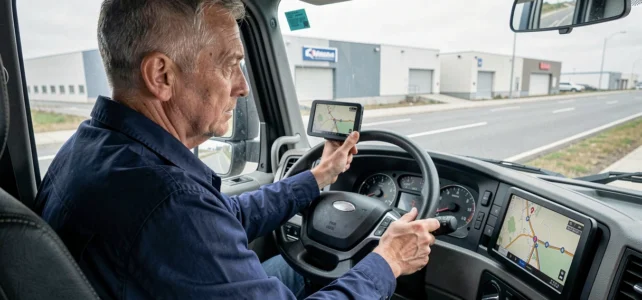
A truck GPS calculates its routes based on the vehicle’s dimensions, not just the distance or travel time. Height, width, length, total weight, type of cargo transported: these parameters determine which roads are passable and which must be excluded. Among the devices dedicated to this calculation, the Snooper Truckmate range has become popular among European truck drivers thanks to a navigation engine specifically designed for the constraints of heavy goods vehicles.
Route calculation by dimensions: what the Truckmate engine processes differently
On a standard GPS, the software looks for the fastest or shortest route. The Snooper Truckmate engine works differently: once the truck’s dimensions are entered, it automatically excludes bridges that are too low, roads with weight limits, tunnels prohibited for certain types of cargo, and sharp turns that are too tight for an articulated vehicle.
This exclusion is not limited to a simple warning. The device recalculates a complete route that avoids obstacles, instead of just signaling a low bridge when the truck is already in a lane with no possibility of turning around. The difference is significant: the detour is anticipated, not endured.
For drivers transporting hazardous materials, the settings also take into account ADR restrictions. Choosing the Snooper truck GPS means delegating to the software the verification of route compliance with the type of cargo, which reduces the risk of violations on roads where signage is sometimes incomplete.
Real-time safety alerts: slopes, turns, and route forcing
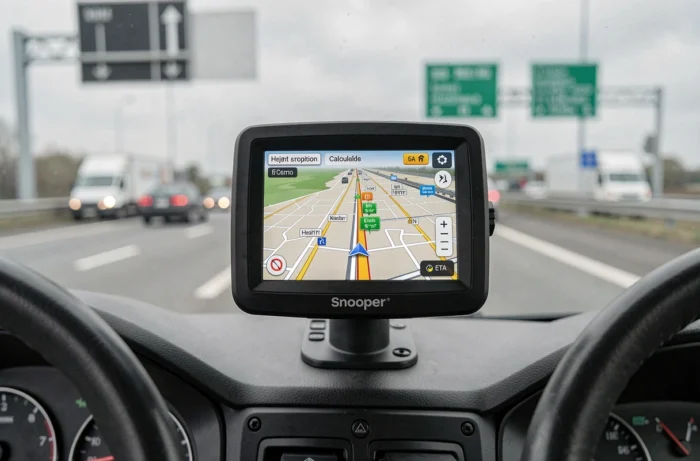
Beyond route calculation, Snooper navigation integrates contextual alerts during driving. The system signals significant uphill slopes, tight turns where the vehicle’s dimensions pose a risk of sweeping, and areas exposed to strong crosswinds.
Forcing alerts provide an additional safety net. If the driver deviates from the calculated route and enters a road incompatible with their dimensions, the device triggers a specific warning. This mechanism limits situations where a driver follows a local visual indication (poorly placed sign, temporary detour) without realizing that the road becomes impassable a few kilometers ahead.
Search by industrial zones and multi-stop planning
Heavy goods deliveries do not go to a typical residential address. The destination is often a unloading dock in an industrial area, a business zone, or a business park. Snooper offers a dedicated search engine that allows locating these areas in relation to the current position or a chosen geographic point.
This function avoids a common problem with standard GPS: guiding to the main entrance of a municipality when the industrial area is located on the outskirts, accessible via a distinct heavy goods access.
The MultiRoute technology complements this system by allowing the planning of a tour with multiple stops. The software optimizes the order of stops while considering the dimensions at each segment, which avoids having to manually reprogram the GPS between each delivery.
Points of interest tailored for truck drivers
The Snooper database references points of interest specific to road transport:
- Rest areas and secure parking accessible to heavy goods vehicles, with capacity indication
- Service stations compatible with the dimensions of road vehicles, including access via dedicated lanes
- Washing zones, repair workshops, and heavy goods technical control centers near the route
This information is not included in mapping databases intended for light vehicles. A driver looking for a suitable rest area on a car GPS or a public app gets unusable results, as the displayed parking lots do not accept vehicles over 3.5 tons.
Regulatory compliance and route traceability in 2026
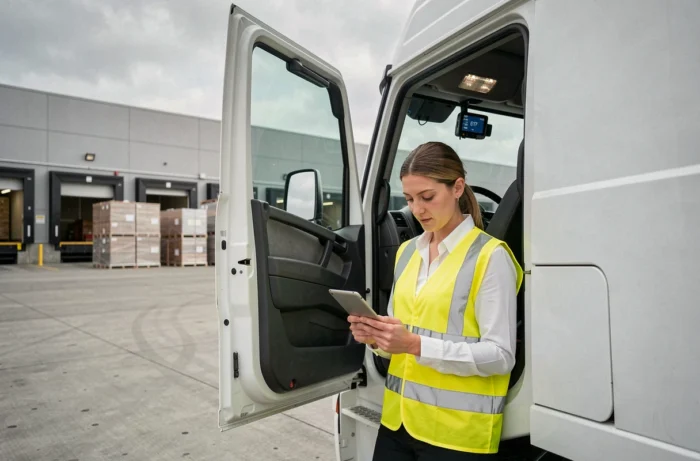
Since July 1, 2026, utility vehicles weighing between 2.5 and 3.5 tons performing international transport or cabotage must be equipped with a second-generation smart tachograph. The rules for driving and rest times are now aligned with those of classic heavy goods vehicles.
During inspections, drivers must present data covering the last 56 days, compared to 28 previously. This extension of the traceability window makes inconsistencies in routes or travel times much more visible to authorities.
A truck GPS that avoids detours, blockages, and forced turns directly contributes to compliance. Every unnecessary kilometer extends the driving time recorded by the tachograph. An optimized route by dimensions mechanically reduces the risk of exceeding regulatory durations, which protects the driver and the transport company during inspections.
Geolocation and CNIL framework
The geolocation of professional vehicles remains permitted within a precise framework: safety of people and goods, optimization of tours, proof of intervention. A dedicated GPS like the Snooper Truckmate, which operates locally on the device without systematic transmission of position data to a third-party server, simplifies compliance with CNIL requirements regarding the proportionality of tracking.
Heavy goods mapping and European coverage
The Snooper Truckmate range uses HERE mapping covering 46 European countries, with lifetime updates included. This coverage incorporates traffic restrictions specific to heavy goods vehicles by country, which is particularly useful for international routes where regulations vary from one territory to another.
Recent models in the range also offer an integrated dashcam that continuously records the road. In the event of an incident, the timestamped video serves as usable evidence for insurance or in case of a dispute.
- Models with touch screens from 4.3 to 7 inches, readable in the cabin even in full sunlight
- Hands-free phone function and rear camera input on mid-range and high-end models
- Lane change assistant for complex highway interchanges
Choosing a GPS dedicated to road transport is not about comfort but about risk management. An unsuitable route for the vehicle’s dimensions generates delays, potential violations, and dangerous situations. With the strengthening of traceability controls since 2026, the accuracy of guidance becomes a factor of compliance as well as productivity.