
An artistic preparatory course is a one-year post-baccalaureate program whose primary function is to prepare for the entrance exams of higher art and design schools. It does not award a diploma in itself: its final product is a well-argued portfolio, a structured visual culture, and the ability to defend a project before a jury.
Three models of artistic preparatory courses with distinct admission logics
Not all candidates aim for the same type of structure, and the access modalities vary greatly from one model to another. Three families coexist with very different philosophies.
The public preparatory courses affiliated with higher art schools, often grouped within the APPEA, are almost free. Their selection is primarily based on an artistic portfolio and a motivation interview. Public preparatory courses boast success rates in entrance exams close to 90%, making them the most effective pathway for schools under the Ministry of Culture.
Preparatory courses integrated into private schools (such as Atelier de Sèvres, Prép’art, or intuit.lab) function as a first year of study. Admission is generally based on academic records, a motivation letter, and an interview. The portfolio is not always required upon entry since the preparatory course is intended to help build it.
Independent private preparatory courses, which are more expensive, often accept a broad profile and focus on intensive support. Their selectivity at entry is lower, but the financial investment should be weighed against the actual placement rate in schools. For more information on the Les 4 Vérités website, this distinction between models is also detailed.
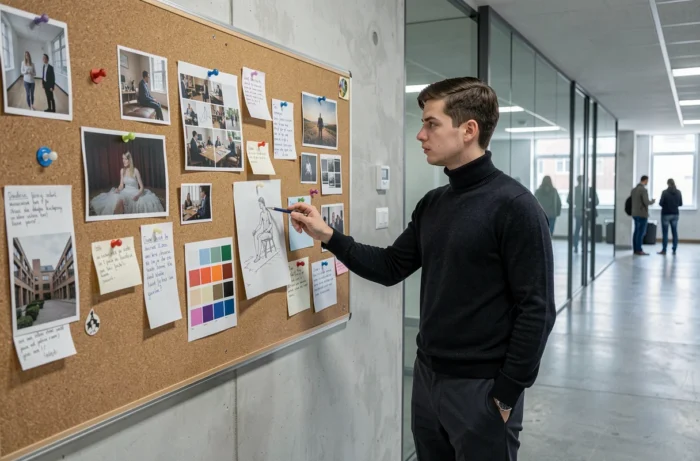
Artistic portfolio: the primary selection criterion over academic records
For the most selective art schools, the well-argued portfolio has become the primary selection criterion, clearly surpassing final year grades. This shift changes how one must prepare their application.
An effective portfolio is not just a compilation of works. The jury evaluates the coherence of vision, the ability to experiment, and the visible progression between earlier pieces and the most recent ones.
What the jury is concretely looking for in a portfolio
- A diversity of mediums (drawing, sculpture, photography, video, collage) that demonstrates genuine technical curiosity, not premature specialization
- A guiding thread or identifiable sensitivity: the jury wants to understand how the candidate sees the world, not just what they can do
- Annotations or accompanying text that explains the approach, artistic choices, and references used for each project
- Personal works created outside the school framework, which demonstrate autonomous practice and commitment to creation
The frequent temptation is to multiply the pieces. A portfolio of twelve to fifteen well-documented projects is better than a file of thirty works without explanation. Each piece must be defensible orally.
Admission interview for art preparatory courses: what sways the decision
The interview generally lasts between fifteen and thirty minutes. The jury is not looking for an accomplished artist. They evaluate potential, maturity of thought, and the ability to question oneself.
The personal presentation occupies the first few minutes. It should clearly outline the background, the reasons for choosing an artistic preparatory course, and the areas that attract the candidate. Reciting a memorized text is immediately noticeable.
Three points that make a difference during the oral interview
The personal artistic culture carries significant weight. Citing a recently visited exhibition, an artist whose work provoked reflection, or a film that influenced their practice shows the jury that the candidate is engaged in a vibrant field of references.
The ability to speak about one’s own works with perspective is as important as their technical quality. A candidate who explains why a project did not work and what they learned from it impresses more than one who only presents successes.
The posture in response to destabilizing questions is a classic test. The jury may ask to comment on an unknown artwork, propose a project idea within a limited time, or justify a questionable artistic choice. The ease of thinking aloud takes precedence over the perfect answer.

Parcoursup and schools outside the platform: adapting your application strategy
Some artistic preparatory courses recruit via Parcoursup, while others operate with their own admission calendar. This duality requires managing two processes in parallel.
On Parcoursup, the motivation letter (motivated training project) and school reports form the foundation of the application. Public preparatory courses listed there sometimes require a supplement in the form of a digital portfolio to be sent directly to the institution.
Schools outside Parcoursup, often private, set their own application deadlines. Some organize admission sessions as early as November, well before Parcoursup opens. Applying early to these schools allows for securing a spot while waiting for responses from the national platform.
- Check as early as September if the targeted preparatory courses go through Parcoursup or an independent process
- Prepare two versions of the application: an academic version for Parcoursup and a project-oriented version for direct applications
- Plan the interview dates for schools outside the platform to avoid overlaps with the baccalaureate exams
The choice between public and private preparatory courses is not solely about cost. The geographical proximity to the targeted higher schools, the specialization of the preparatory course (visual arts, design, animation, architecture), and the alumni network influence the decision as much as the budget.
The artistic preparatory course remains a transitional year whose success depends less on the prestige of the institution than on the personal investment of the candidate in their daily practice and in developing a unique perspective.