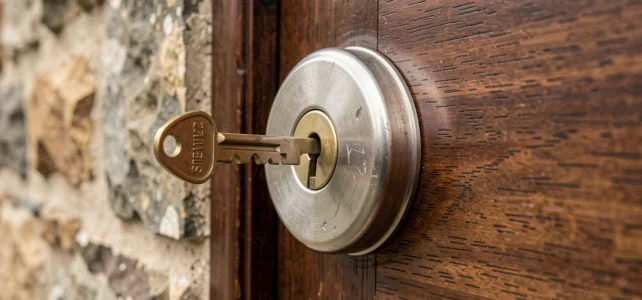
The key-operated lock remains the most commonly installed device in addition to a main lock, but not all models withstand the same constraints. Comparing their technical characteristics allows for a real assessment of the protection gap between a simple button lock and a certified security lock, especially when recent data on burglaries point to very specific attack methods.
Pulling and crowbar: the attacks your lock must actually stop
Standard content often goes into detail about resistance to lock picking. The figures from the Ministry of the Interior’s Statistical Service (SSMSI) for 2024-2025, reported by Notre Temps and Capital, describe a different reality: about 70% of burglaries occur through the front door, and intrusions often last less than five minutes.
The most common techniques are the crowbar, lever, and cylinder pulling. Fine picking, often highlighted in buying guides, represents a marginal share of residential break-ins.
This data changes the perspective: a high-performing key-operated lock must first withstand brute force. The quality of the bolt (its length, diameter, and composition in hardened steel) and the protection of the cylinder against pulling are more important than the theoretical complexity of the key. Before asking which type of key-operated lock to choose, it is essential to identify the most likely mode of attack on your door.
Button lock, double cylinder, and security lock: comparative table
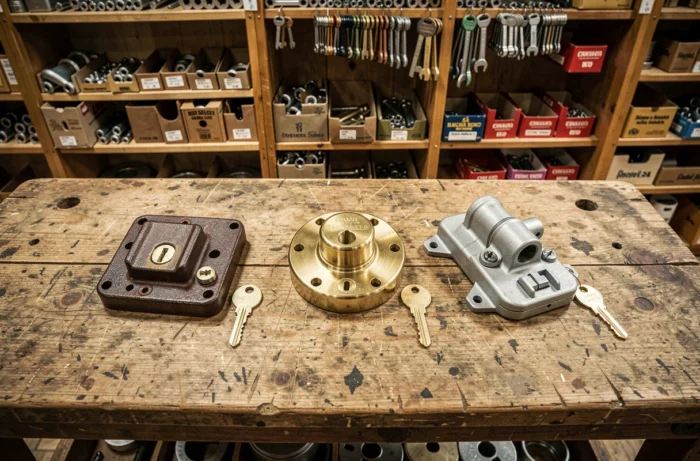
Three main families of locks coexist in the market. Their differences lie in the locking mechanism, resistance to break-in, and level of certification.
| Type of lock | External locking | Internal locking | Resistance to pulling | A2P certification possible |
|---|---|---|---|---|
| Button lock | Key | Rotating button (keyless) | Low to medium | No (generally) |
| Double cylinder lock (double entry) | Key | Key | Medium | Yes (depending on model) |
| Reinforced security lock | High-security key | Key or armored button | High (anti-pulling rosette, long bolt) | Yes (A2P*, A2P** or A2P***) |
The button lock is suitable for interior doors or uses where quick opening is a priority. However, it offers little resistance against a lever attack, as its internal mechanism is often simplified.
The double cylinder lock requires a key on both sides. It complicates the task for an intruder who would break a glass panel to reach the interior button. The double cylinder protects against opening by breaking glass, a common scenario on doors with glazing.
The reinforced security lock includes a cylinder protected by an armored rosette, a wide-section steel bolt, and, on certified models, anti-picking and anti-drilling pins. It is the only type that meets the requirements of the A2P standard.
A2P standard and cylinder resistance: what the stars measure
The A2P certification, issued by the CNPP, classifies locks and latches according to their timed resistance to break-in. There are three levels.
- A2P* (one star): resistance tested against simple manual tools. Suitable as a supplementary locking device on a door already equipped with a multi-point lock.
- A2P** (two stars): resistance extended to more elaborate tools, with a longer break-in time during tests.
- A2P*** (three stars): maximum level, tested against power tools. Recommended for entrance doors facing the street or ground floor.
The cylinder of the lock has its own certification, independent of that of the housing. An A2P** lock equipped with a non-certified cylinder loses a significant part of its resistance. The cylinder must be certified at the same level as the lock for the advertised protection to be effective.
Another often overlooked technical point: the length of the cylinder protruding from the door. A cylinder that protrudes more than a few millimeters offers an easy grip for pliers. Models with flush protective rosettes reduce this risk.
Key-operated lock on entrance door: selection criteria based on configuration
The type of door influences the choice of lock as much as the desired level of security. Three technical parameters should be checked before purchase.
Thickness and material of the door
A surface-mounted lock is fixed on the inner face. It requires sufficient door thickness for the fixing screws to ensure proper mechanical hold. On a thin PVC door or softwood, standard screws can be pulled out under a crowbar strike. Metal back plates on the exterior side compensate for this flaw.
Presence of glazing
On a glazed door, the internal button lock is a vulnerability: an intruder can break the glass and turn the button. The double cylinder eliminates this risk. Glazed door = double cylinder mandatory for the lock to remain useful.
Compatibility with existing lock
The lock is generally installed above the main lock, sometimes below. If the door is equipped with a multi-point lock, the supplementary lock reinforces the top of the leaf, an area often less securely held. The bolt of the lock must engage in a strike plate securely anchored in the frame, ideally reinforced by a metal shoe.
Burglaries with occupants present: why internal locking matters
SSMSI data for 2024-2025 indicates that about 40% of burglaries occur while someone is present in the home. This proportion has increased in recent years. The key-operated lock, quickly operable from the inside, provides an additional barrier even when the main lock has not been locked.
A button lock allows for instant locking without searching for a key. A double cylinder lock, safer against external intrusion, requires having the key nearby to avoid blocking an emergency evacuation. This compromise between anti-intrusion security and fire safety must be evaluated on a case-by-case basis, especially in homes with children or elderly individuals.
Thus, the choice of the key-operated lock relies less on aesthetic preference than on a cross-analysis: dominant attack mode (pulling, lever), door configuration (glazing, thickness, existing lock), and occupancy scenario of the dwelling. A certified A2P lock, installed with a protected cylinder at the same level and a reinforced strike plate, covers the majority of risks documented by recent statistics.