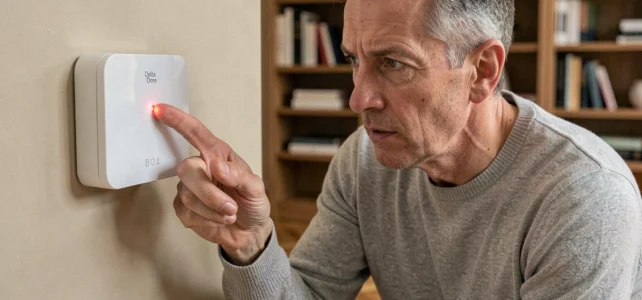
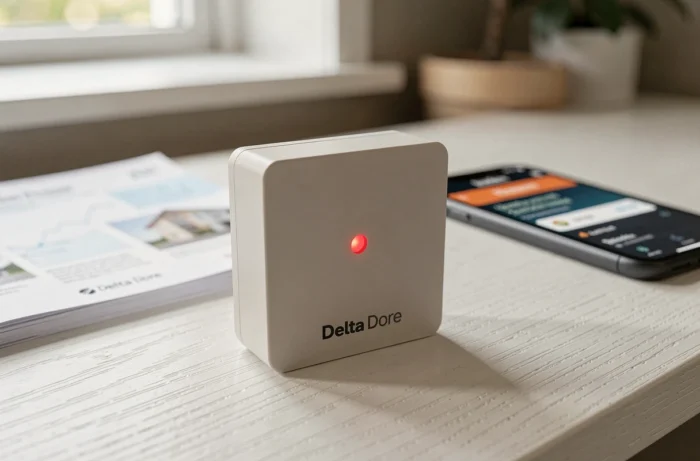
A red light that stays continuously lit on a Delta Dore module often provokes the same reaction: something is wrong. The reflex is to look for a fault. Depending on the model in question (GP 500 load shedding device, heating receiver, Tyxal alarm), the meaning changes completely. Understanding what this indicator light actually signifies avoids unnecessary interventions and allows for a quick response when the problem is real.
Solid red light on the GP 500 load shedding device: normal state or prolonged anomaly
Have you noticed a red light permanently lit to the left of your Delta Dore GP 500? This is the most common case on forums. And the answer is not immediately clear-cut.
On this load shedding device, the solid red light indicates an ongoing load shedding. The device temporarily cuts off certain loads (water heater, radiators) to prevent the main circuit breaker from tripping. In this case, the light is normal: it is doing its job.
The problem arises when this state lasts for several hours while your actual consumption is low. The first lead concerns the measurement toroid, this small ring placed around the phase wire in the electrical panel. A poorly positioned or loose toroid transmits a distorted measurement to the load shedding device, which believes there is a permanent overload.
The second lead is a wiring fault on the outputs of the GP 500, particularly on the line dedicated to the water heater.
To delve deeper into this distinction between normal operation and alert signal, an article details the solid red light on Delta Dore and the associated diagnostic steps.
A load shedding that lasts beyond one hour without visible reason requires a check of the toroid and connections. If after repositioning the toroid and checking the connections the light persists, a reset of the device (cutting power at the circuit breaker for about ten seconds and then restoring power) may suffice to restore proper operation.
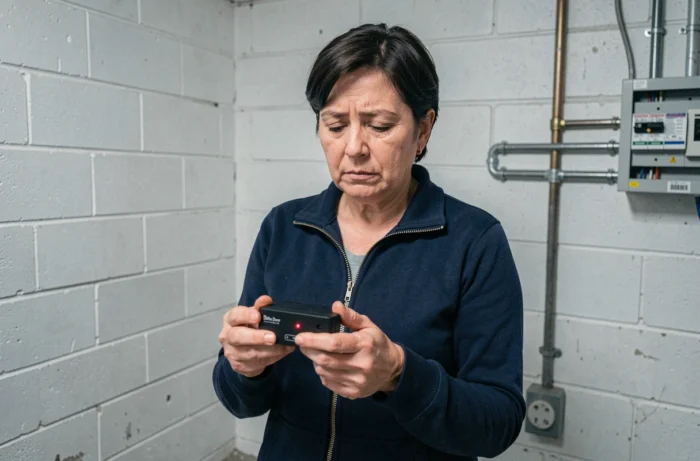
Solid red light and water heater: the link with the day/night contactor
The typical scenario: no hot water at the end of the day, and a red light lit on the GP 500 at the water heater output. Before blaming the load shedding device, check the day/night contactor in your electrical panel.
The off-peak contactor receives a signal from your energy supplier (via the teleinformation from the Linky meter or the old EDF signal) to trigger the water heater during the advantageous tariff periods. If this signal no longer reaches the contactor, the water heater never starts, and the load shedding device displays a state of permanent load shedding on this line.
Here are the checks to perform in order:
- Check the position of the contactor: it should be on “auto”, not on “0” (off) or “1” (forced on). Switching to forced mode allows you to test if the water heater works independently of the off-peak signal.
- Check the pilot wire between the meter and the contactor. In older installations, a loose wire on the contactor terminal can cut communication without tripping a circuit breaker.
- Test the teleinformation: on a Linky meter, terminals I1 and I2 transmit the signal. A multimeter set to AC can verify that a voltage appears during off-peak hours.
If the contactor works in forced mode but not in automatic mode, the problem lies with the off-peak signal, not with the Delta Dore.
Tyxal Delta Dore Alarm: a red light indicating power supply issues
On Delta Dore alarm systems (notably the Tyxal range), the solid red light on the control panel has a different meaning. It is generally related to the power supply or backup battery.
A solid red light on the Tyxal control panel often indicates a failing internal battery. This battery takes over in case of a power outage. When it ages or fails, the control panel signals this with the indicator light.
Before contacting an installer, check that the power transformer is properly connected and delivering the expected voltage. If the mains power is correct but the light remains red, replacing the internal battery is the most likely solution.
Another scenario exists: a sensor (opening detector, motion detector) with a weak battery can cause a supervision fault on the control panel. The red light is then accompanied by a message on the keypad or the Tydom app. Check the event history on the keypad to identify the affected sensor.
Resetting and cases where an electrician’s intervention is necessary
Electrical resetting (turning power off and then back on) resolves some persistent red lights, particularly on the GP 500 after a storm or a brief power cut. But it does not replace a diagnosis when the problem recurs.
Call a professional in these situations:
- The red light consistently reappears after each reset, even without any load connected to the affected output.
- You notice abnormal heating at the module or wires in the electrical panel.
- The main circuit breaker repeatedly trips despite reduced consumption, which may indicate an insulation fault on the circuit.
- The load shedding device exhibits inconsistent behavior across multiple lines simultaneously.
Heating of connections in the electrical panel warrants prompt intervention. This type of fault exceeds the scope of domestic troubleshooting and can pose a risk.
For older models whose manual is no longer available on the Delta Dore site, platforms like Notice-facile reference technical documentation by brand and model. Finding the interpretation table for the indicators specific to your device remains the most reliable way to distinguish normal operation from a real fault.